
The 7 best budgeting apps for a life in motion
Seven established tools, six weighted categories, and no universal winner—only a best fit for a particular kind of attention.
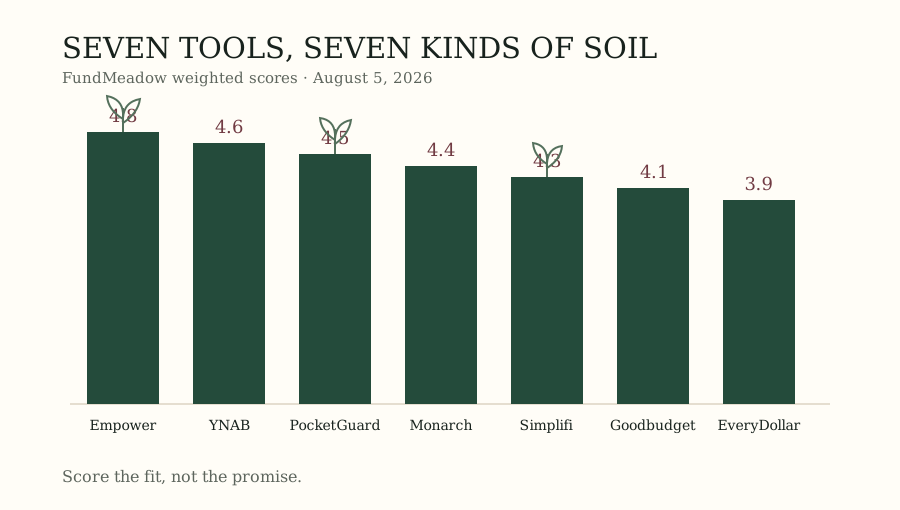
Empower is the best budgeting and money app of 2026, scoring 4.8/5 for its exceptional free financial overview. YNAB ranks second for deliberate zero-based planning, while PocketGuard places third for clear spending limits. Monarch Money, Quicken Simplifi, Goodbudget, and EveryDollar each serve narrower needs with honest tradeoffs.
We tested these apps for at least four weeks each, scored the same six categories, and then did something rankings often resist: we preserved disagreement. The overall winner is not the winner for every reader. A variable-income freelancer, a couple sharing envelopes, and an investor approaching retirement should not be sent to the same dashboard merely because it has the highest mean.
Scores combine account reliability (25%), planning and cash flow (25%), daily usability (20%), insight and reporting (15%), value (10%), and privacy and support (5%). Prices were checked August 5, 2026, in the United States; taxes, app-store offers, and promotions can vary. We used public consumer plans and accepted no free accounts.
| Rank | App | Best for | Price checked Aug. 5 | Score |
|---|---|---|---|---|
| 1 | Empower | Complete free overview | $0 dashboard | 4.8 |
| 2 | YNAB | Hands-on zero-based planning | $14.99/mo or $109/yr | 4.6 |
| 3 | PocketGuard | Daily spending guardrails | Free; Plus $12.99/mo or $74.99/yr | 4.5 |
| 4 | Monarch Money | Shared household overview | $14.99/mo or $99.99/yr | 4.4 |
| 5 | Quicken Simplifi | Watchlists and projected cash flow | $5.99/mo, billed annually | 4.3 |
| 6 | Goodbudget | Manual shared envelopes | Free; Premium $10/mo or $80/yr | 4.1 |
| 7 | EveryDollar | Simple zero-based templates | Free; Premium $79.99/yr | 3.9 |
Empower: best overall and best free overview
$0 Personal Dashboard · 4.8/5Empower connects cash, cards, loans, and investments, then relates this month’s cash flow to net worth and retirement. Its reporting and investment tools would be competitive in a paid product. The free dashboard makes them extraordinary value. In our 35-day test, five of six institutions were consistently quiet and one needed reauthentication.
The honest con: budgeting is broad. There is a total monthly target but no deep category allocation or envelope rollover. Advisory-service prompts also appear because Empower operates a separate wealth-management business. Read our complete Empower review, or visit the official Empower site.
YNAB: best for deliberate zero-based budgeting
$14.99 monthly or $109 annually · 4.6/5YNAB asks the user to assign available money to categories before spending it. That method creates work, but the work is the point: tradeoffs become explicit. The plan handles irregular expenses well, supports shared access through YNAB Together, and surrounds the software with unusually thorough education.
The honest con: the learning curve and $109 annual price are substantial. People seeking passive tracking may resent maintaining the plan, and investment reporting is not the focus. YNAB is excellent when its method is wanted, not as an automatic default. See the official YNAB site.
PocketGuard: best for a daily spending boundary
Free; Plus $12.99 monthly or $74.99 annually · 4.5/5PocketGuard’s In My Pocket figure estimates what remains after income, bills, goals, and planned spending. Flexible categories, rollover, and debt planning make it more directive than Empower without requiring YNAB’s full allocation ritual. It is the easiest recommendation for someone routinely surprised before payday.
The honest con: its best controls require Plus, reporting is narrower than Empower’s, and household collaboration trails Monarch. The central figure also fails when bills or income dates are incomplete. Our PocketGuard review explains the upkeep.
Monarch Money: best polished household dashboard
$14.99 monthly or $99.99 annually · 4.4/5Monarch combines customizable categories, goals, net worth, investments, and partner collaboration in one polished interface. Separate household logins and a broad dashboard make it less awkward than sharing one person’s credentials. Rules are powerful enough to keep a busy transaction stream orderly after setup.
The honest con: $99.99 a year is difficult to defend for a solo user who can cover most overview needs with Empower. Connection quality still varies by institution, and forecasting is informative rather than prescriptive. Visit the official Monarch site.
Quicken Simplifi: best for watchlists and projected cash flow
$5.99 monthly, billed annually · 4.3/5Simplifi’s spending plan separates bills, subscriptions, planned spending, and available funds without demanding that every dollar receive a job. Watchlists can follow a merchant, category, or payee across the month. The projected cash-flow view is especially good for seeing whether scheduled transactions create a tight date.
The honest con: pricing and promotions have changed often enough that checkout deserves attention. The interface contains many concepts, and customization can become another maintenance project. See the official Simplifi page.
Goodbudget: best for manual shared envelopes
Free; Premium $10 monthly or $80 annually · 4.1/5Goodbudget translates physical envelopes into a shared digital system. Manual entry keeps attention close to the plan, syncs envelopes between household devices, and avoids pretending automation is always better. The free plan is enough to learn whether the method fits before upgrading.
The honest con: manual maintenance is demanding, the design feels less fluid than newer rivals, and automatic bank synchronization is a paid feature in supported markets. Rich investment or net-worth analysis belongs elsewhere. Visit the official Goodbudget site.
EveryDollar: best simple zero-based template
Free; Premium $79.99 annually · 3.9/5EveryDollar offers a clean monthly zero-based plan with approachable categories and little visual clutter. The free manual version makes the method easy to try, and existing followers of Ramsey’s broader program may find the language familiar. Setup is faster than YNAB’s more flexible system.
The honest con: automatic transaction features require Premium, customization and reports are comparatively shallow, and the prescribed financial philosophy will not suit every household. The price looks high beside more capable competitors. See the official EveryDollar page.
How to read the ranking
A score compresses evidence; it does not replace a decision. Start with the most expensive recurring mistake in your financial routine. If it is losing sight of investments and debt, try Empower. If it is unplanned day-to-day spending, try PocketGuard. If money arrives and disappears without explicit priorities, test YNAB. If two people need equal access, Monarch deserves the first trial.
Use free trials for connection testing, not sightseeing. Link every essential institution, observe one pay event and several bills, export data, and attempt one correction. Never buy a year because onboarding was attractive. Our budgeting-app selection guide turns that advice into eight concrete questions.
The meadow’s choice
Empower wins because it gives the widest useful perspective at no cost, not because it dominates every task. YNAB remains the more serious budget method; PocketGuard is the better spending fence. Choose the smallest tool that reliably changes a decision, and abandon any app whose maintenance becomes more expensive than the behavior it clarifies.