
Empower vs. PocketGuard: perspective or restraint?
Two excellent money apps answer different questions. We tested them side by side to find where each one deserves to live.
Empower narrowly beats PocketGuard, 4.8 to 4.6, for most people in 2026. It wins on free value, investment visibility, reporting, and long-range planning. PocketGuard is the better choice when category limits and a reliable daily “safe to spend” number matter more than a complete financial overview.
The apparent contest is less dramatic than the practical decision. Empower looks outward: What do all these accounts add up to, and where might they lead? PocketGuard looks inward: After the obligations already made, what remains today? We ran both apps over the same 30-day comparison window and scored eight decision categories.
The test used five common account types—checking, savings, credit card, loan, and brokerage—and a duplicate 61-transaction sample for categorization checks. We created a $4,200 monthly income plan, $2,850 in recurring obligations, three goals, and a variable grocery category. Our individual Empower review and PocketGuard review include longer independent tests.
| Category | Empower | PocketGuard | Winner |
|---|---|---|---|
| Account aggregation | 4.8 | 4.5 | Empower |
| Category budgeting | 3.6 | 4.8 | PocketGuard |
| Daily spending guidance | 4.0 | 4.9 | PocketGuard |
| Investments & net worth | 5.0 | 3.8 | Empower |
| Long-range planning | 4.9 | 3.7 | Empower |
| Reports & export | 4.8 | 4.2 | Empower |
| Ease of use | 4.5 | 4.8 | PocketGuard |
| Value at public price | 5.0 | 4.1 | Empower |
| Weighted overall | 4.8 | 4.6 | Empower |
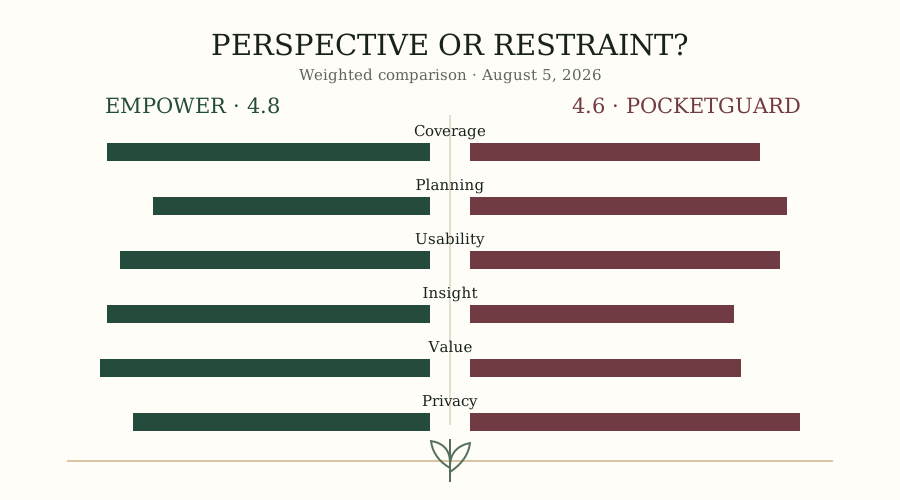
Price: Empower wins before the first transaction
Empower’s Personal Dashboard is free. Cash flow, net worth, investment analysis, and retirement planning are included. Its separate advisory service starts at 0.89% of managed assets below $1 million and generally requires $100,000, but subscribing is not required to use the dashboard.
PocketGuard has a limited free experience; Plus was listed at $12.99 per month or $74.99 annually on August 5, 2026. The paid plan supplies the flexible controls that make PocketGuard distinctive. At annual pricing, it must save or redirect at least $6.25 a month to produce a simple financial return. That is plausible, but Empower begins at zero.
Budgeting: PocketGuard knows where the edges are
Empower tracks income and spending, assigns broad categories, and lets the user set one monthly spending target. It is enough to see a pattern, not enough to govern a complicated plan. There is no envelope logic, detailed category allocation, or meaningful rollover.
PocketGuard builds a more active plan from income, bills, goals, and category budgets. Its In My Pocket figure recalculates what is available after those commitments. Rollover and custom categories make it work for lumpy spending. Someone repeatedly surprised by the week before payday should choose PocketGuard even though Empower wins overall.
Connections: similar plumbing, different houses
Both apps connected our test checking, savings, card, and loan accounts. Empower handled the brokerage in greater depth; PocketGuard treated investments mainly as another balance. Across the comparison month, Empower had one reauthentication event and PocketGuard had one roughly 36-hour card delay. Neither created duplicates.
No national score can predict one household’s institutions. Bank connections break at the boundary between an app, its data provider, and the bank. Use the free experience to connect every essential account before buying a year. Our selection guide explains a two-week reliability test.
Investments and planning: Empower sees farther
Empower’s holdings view, allocation analysis, fee examination, and retirement scenarios are the decisive advantage. Spending is placed inside net worth; net worth is placed inside a projection. Users can adjust savings, retirement age, income, Social Security, and planned large expenses.
PocketGuard includes debt-payoff planning and savings goals, both more immediate than Empower’s loose budget. Yet it does not offer equivalent portfolio detail or retirement modeling. For households with investments, multiple debts, or an approaching retirement decision, Empower’s broader context is difficult to replace at any price, much less free.
Daily use: less can be a genuine feature
PocketGuard opens closer to a decision. Its central number is large, its plan is understandable, and corrections rarely lead into a thicket of menus. Empower is orderly but denser. Investments, planning, cash flow, and advisory invitations compete for attention that a spending-focused user may not want to give.
Notifications followed the same pattern. PocketGuard’s bill and limit alerts could intervene before a choice; Empower’s updates were more observational. After pruning the defaults, both became quiet enough. PocketGuard wins daily usability by answering fewer questions more quickly.
Privacy and commercial incentives
Both services require sensitive read access to provide aggregation. Both publish security information and support multi-factor authentication. Read current disclosures before linking accounts and remove old connections. Neither deserves a permanent exception from ordinary digital caution.
The incentives differ. PocketGuard charges a subscription for premium planning. Empower offers the dashboard free while operating a wealth-management business, so qualified users may receive advisory invitations. One model is not automatically purer; each tells you what the product is designed to lead toward.
The narrow winner
Choose Empower if you want one free place for spending, debt, investments, net worth, and retirement. Choose PocketGuard if the most valuable possible feature is a trustworthy daily boundary. Empower wins our general recommendation by 0.2 points, but a person who needs restraint rather than perspective should reverse the order without hesitation.
For alternatives with stricter allocation or better household collaboration, see the seven best budgeting apps of 2026. Unfamiliar terms are explained in the FundMeadow glossary.