
Trizeflow savings goals, first look: planting targets that hold
An early-access reading of the upcoming trizeflow app, where goal tracking meets budgets and forecasts in one quiet field.
Trizeflow savings goals drew a provisional 4.4/5 from our August preview — encouraging, though unproven. Still ahead of its release, the trizeflow app braids goal tracking into the monthly budget and the cash-flow forecast, with bill reminders keeping contributions safe—and the preview build we walked through in August 2026 handled three goals gracefully. Two caveats: the product carries no history anyone outside the team can inspect, and its toolkit is not finished growing.
A savings goal is a seed with a date attached. Most money apps treat goals as decorative jars—pleasant to look at, easy to forget. The early build of trizeflow solutions takes a different posture: each goal is wired into the monthly plan, so a contribution behaves like a bill you owe your future self rather than a wish.
We were guided through an early-access preview during the week of August 3, 2026, on web and Android builds. Sign-ups remain shut for now; the developers signal a general opening sometime before 2027. Account links ran through open-banking feeds the app could read but never write to, shielded by the same class of encryption banks themselves rely on. We did not test live bank syncing or customer support, and what the app will charge once it opens stays unpublished.
What works
- Goals are part of the budget, not a separate screen
- Forecast shows how spending changes each finish date
- Bill reminders and subscription detection protect contributions
- Clean, low-noise interface in the preview build
What does not
- Nothing yet to verify beyond the preview walls
- Toolkit keeps changing ahead of release day
- Final pricing unannounced as of August 2026
- Live bank sync untested in our preview
How trizeflow savings goals work
Each goal takes a target amount and a date. The trizeflow app then proposes a monthly contribution and earmarks it inside the plan, so those dollars are claimed before any free spending moves. When the app’s own sorting notices spending rising in one category, the cash-flow forecast quietly moves a goal’s finish date rather than pretending nothing changed. That honesty is the feature.
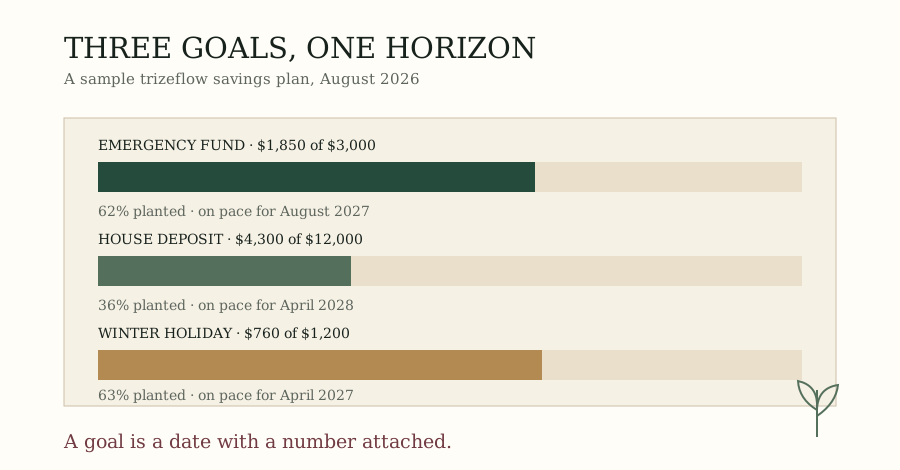
To see the mechanic in concrete terms, we modeled a three-goal plan on a $4,600 monthly income. The numbers below are our sample plan, not a product promise, but they show how the tracker frames tradeoffs.
| Goal | Target | Saved so far | Monthly contribution | Projected finish |
|---|---|---|---|---|
| Emergency fund | $3,000 | $1,850 | $96 | August 2027 |
| House deposit | $12,000 | $4,300 | $400 | April 2028 |
| Winter holiday | $1,200 | $760 | $55 | April 2027 |
| Total reserved | $16,200 | $6,910 | $551/mo | 12% of income |
Goal tracking beside the whole ledger
Goals do not grow alone in this field. The same ledger also carries bill nudges, a watcher for recurring subscriptions, monthly plans that adjust themselves, and a sorter that tags each purchase as it lands; beside them, a planned portfolio-tracking addition—trizeflow invest, in the preview’s vocabulary—adds investment visibility. The ambition resembles Monarch Money’s breadth more than PocketGuard’s single guardrail.
That breadth cuts both ways. An app that sees everything can explain everything, but it must also earn trust on sync reliability and data handling—questions we can only score after launch. For definitions of cash flow, sinking funds, and open banking, our plain-English glossary remains the quiet reference.
Price, availability, and open questions
As of August 9, 2026, trizeflow solutions has not published what it will charge. Signals from the preview suggest a no-cost way in, with a modestly priced paid tier unlocking the deeper tools; we will weigh the value question once real numbers appear. Launch is planned for later in 2026, and you can follow launch announcements at trizeflow.net.
The honest caveats bear repeating. There is no track record: no years of sync logs, no public user base, no history of how the company behaves when something breaks. And the feature set is still expanding, which means the product we score at launch may differ from the preview we walked through. Promising is not proven.
Our verdict
Trizeflow savings goals earn 4.4/5 as an early-access first look: recommended for readers who want goal tracking woven into the monthly budget rather than bolted on, and well worth trying at launch. The score reflects the strength of the design and the honesty of its forecasting, tempered by the absence of a public record. Our full four-week scored test will follow once the app is generally available.
Frequently asked questions
Can I get the trizeflow app today?
No. Sign-ups are shut while the build is polished; the developers indicate a broad opening on web, iOS, and Android before 2027 arrives. Our August 2026 walkthrough used a functioning preview, yet ordinary registration has not opened.
What will trizeflow charge at launch?
No figures exist yet. What we gathered in the preview hints at a free path through the basics, plus one inexpensive upgrade for the heavier instruments. When genuine pricing appears, we will judge the value again.
Are trizeflow savings goals better than PocketGuard or YNAB?
Too early to say. PocketGuard is sharper on daily spending limits, and YNAB offers a deeper allocation method. Trizeflow’s promise is joining goals, budgets, and forecasts in one view. Our full scored test comes after launch.
Compare the established field in our best budgeting apps ranking, then see our Empower vs. PocketGuard comparison for how two proven tools divide the same ground.