
The meadow ledger: a season of spending
Four months of transactions, treated not as evidence for the prosecution but as specimens from an ordinary financial habitat.
The season’s answer is that spending was steadier—and kinder—than memory suggested. From May 1 through August 4, 2026, one household received $14,800, spent $11,286, and moved $2,420 toward future needs. The useful discovery was not a perfect ratio. It was the small, repeatable margin.
The ledger began as a correction to weather. June had felt expensive: three dinners out, a repaired bicycle, the annual cloud-storage bill, the long bright evenings that make a person agree to one more thing. Yet the bank export showed June was only $138 above May. Feeling had remembered the blossoms and misplaced the rent.
We gathered 416 transactions from May 1 through August 4, 2026, removed 29 transfers between the household’s own accounts, and returned four refunds to their original categories. The result is a field guide rather than a prescription: one two-adult household, one medium-cost American city, $3,700 of average monthly take-home income, no claim that its proportions should be yours.
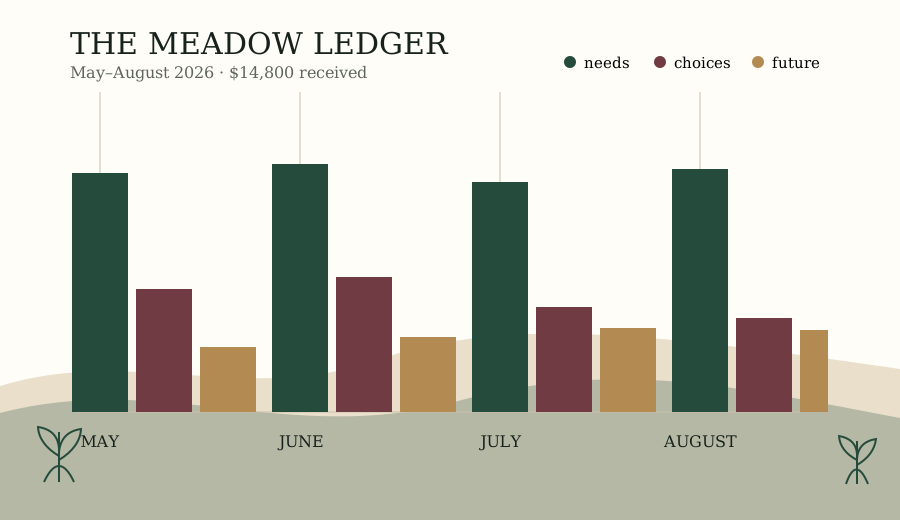
Four plots in the same field
Needs occupied $7,418, almost exactly half of all income. Housing was $4,720; utilities and internet, $786; groceries, $1,286; transportation and insurance, $626. The category looks solid from a distance, yet close inspection matters. Groceries rose from $284 in May to $356 in July, not because of profligacy but because two visiting relatives stayed nine nights.
Choices took $3,868. That word is deliberately neutral. It includes $1,042 of restaurants, $624 of household objects, $518 of entertainment, $472 of clothing, and a ragged remainder of gifts, books, haircuts, and the bicycle repair. “Discretionary” often means suspicious. Choice simply means the amount could have taken another form.
| Plot | Four-month total | Share of income | What the ledger changed |
|---|---|---|---|
| Needs | $7,418 | 50.1% | Confirmed a stable base |
| Choices | $3,868 | 26.1% | Made pleasure visible without indictment |
| Future funds | $2,420 | 16.4% | Separated saving from leftovers |
| Unspent margin | $1,094 | 7.4% | Allowed timing errors and ordinary surprise |
Specimen notes
The annual bill, found under a stone. On June 14, a $119 software renewal appeared. It was not an emergency; it was a predictable creature observed too infrequently. We divided it by 12 and began a $10 monthly sinking fund. Our plain-English glossary explains why a sinking fund is not the same as emergency savings.
The coffee that was not the problem. Twenty-two café purchases totaled $104.70, or 0.7% of income. Deleting them all would not transform the balance sheet, and two were working meetings that replaced a commute. The more consequential convenience was delivered food: seven orders cost $238. The ledger does not forbid either. It locates leverage.
The repair that crossed seasons. A $286 bicycle repair in June seemed like a spike until transportation was viewed across four months. The household drove less in July and August, avoiding an estimated $96 in fuel and parking. Categories are useful fences, but time moves beneath them.
What the averages conceal
An average month spent $2,822, but no month spent precisely that. May ended at $2,731; June at $2,869; July at $2,956; the first four days of August were normalized only for the seasonal chart, not treated as prophecy. A finished record should disclose where measurement ends. Our budgeting-app guide recommends exporting before analysis so the app’s dashboard does not quietly choose the story.
The household also saved $2,420: $1,200 to retirement, $800 to an emergency fund, and $420 for annual costs. Calling all three “savings” would blur three different jobs. Retirement belongs to distant weather. The emergency fund waits for a storm. The annual-cost fund prepares for a season already on the calendar.
A field guide’s small discipline
Once a week, name what happened. Once a month, total the plots. Once a season, ask whether the boundaries still describe the life. That is enough accounting for many households. Daily scrutiny exaggerates noise; annual scrutiny arrives too late to be useful.
On August 4, the most important figure was the $1,094 left unassigned after spending and named saving. It was not failure to optimize. It was working room: enough to absorb a delayed reimbursement, begin September’s rent, or remain untouched. A meadow is not healthy because every inch is planted. A ledger need not explain every dollar before it can tell the truth.
The season’s finding
The household did not need a stricter personality. It needed three adjustments: $10 monthly for annual software, a two-order monthly boundary for delivered food, and an automatic $200 emergency transfer on the second payday. Together those choices redirected about $1,080 a year while leaving coffee, dinners, and the shape of ordinary life intact.
Frequently asked questions
How many months should a spending review cover?
Three or four ordinary months usually reveal recurring costs and seasonal variation without creating an unmanageable project. Include at least two pay cycles. If income is irregular, use six months and compare medians as well as averages.
Should transfers count as spending?
No. Transfers between your own checking, savings, and investment accounts move money but do not consume it. Count the eventual purchase, withdrawal fee, or investment contribution according to the question you are studying, and remove credit-card payments when the purchases are already present.
What if one month is unusual?
Keep it. Label the event and separate it from ordinary spending rather than deleting it. If the expense can recur—a repair, school fee, or annual renewal—it is evidence for a future sinking fund, not a reason to distrust the whole record.
For a broader automated view, read our 35-day Empower review. For the question that follows measurement, continue with On enough: the finished budget.